End-of-Line & Palletizing
Palletizing System

Main function
The palletizing system ensures the automatic, structured, and stable stacking of packaged products onto pallets at the end of a production line, in preparation for storage, transportation, or shipment.
Integrated at the end of the line, it picks products from conveyors and places them according to programmed palletizing patterns ensuring repeatability, throughput, and logistical stability.
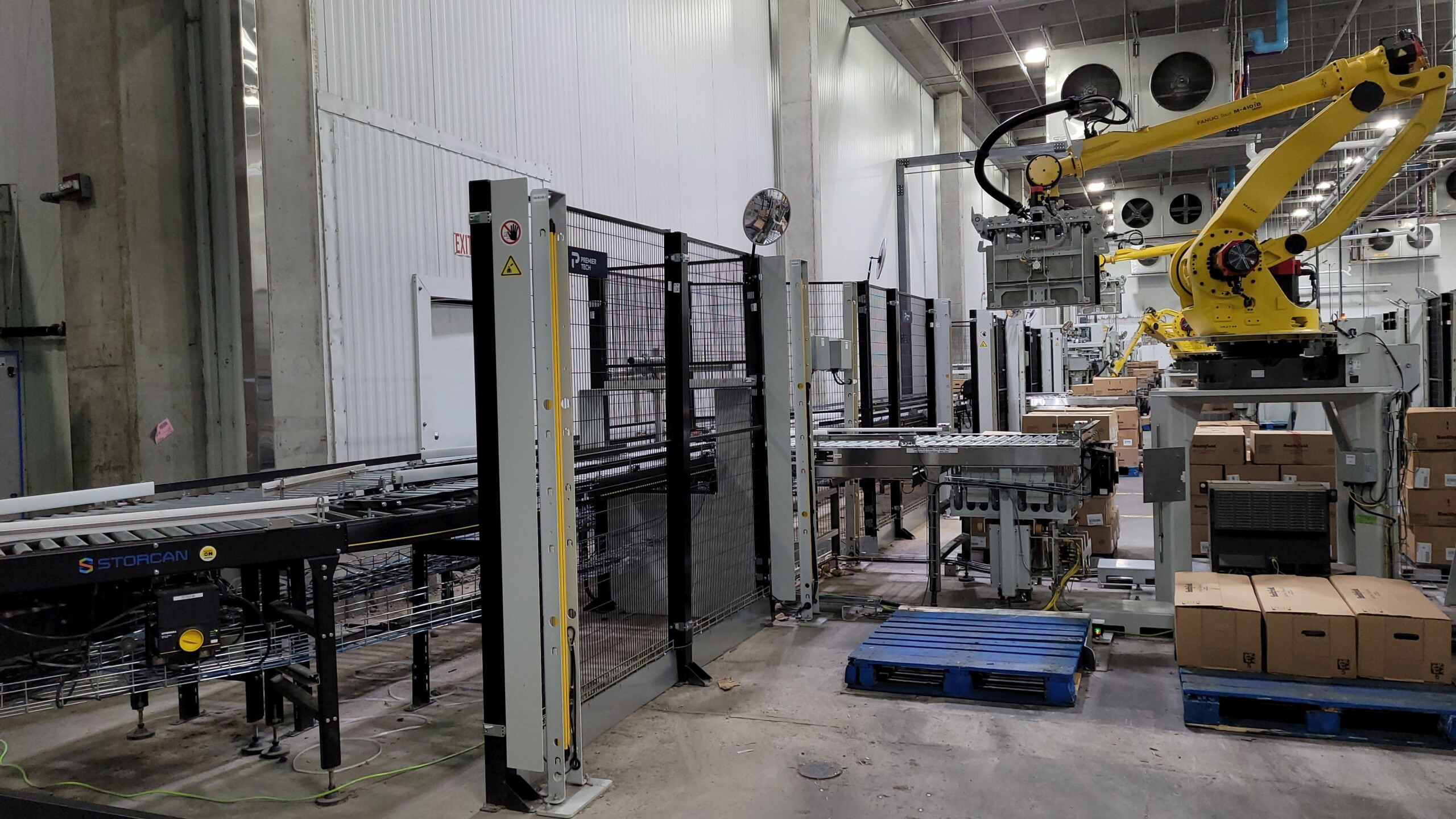
The palletizing system is typically integrated with peripheral equipment to automate the entire process, including empty pallet dispensers, slip sheet dispensers (pallet sheets), as well as perimeter safety devices and protective guarding.
This overall architecture makes it possible to create a complete end-of-line cell, automating logistics preparation without manual intervention.
Typical applications
• Top-load palletizing: Products or layers are placed onto the pallet from an overhead structure. Ideal for uniform lines, regular cartons or bags, high-speed operations, and stable layer formation.
• Low-level / floor-level palletizing: Layers are formed at a lower height and then transferred onto the pallet. Ideal for moderate speeds, operator and maintenance accessibility, and height-constrained lines.
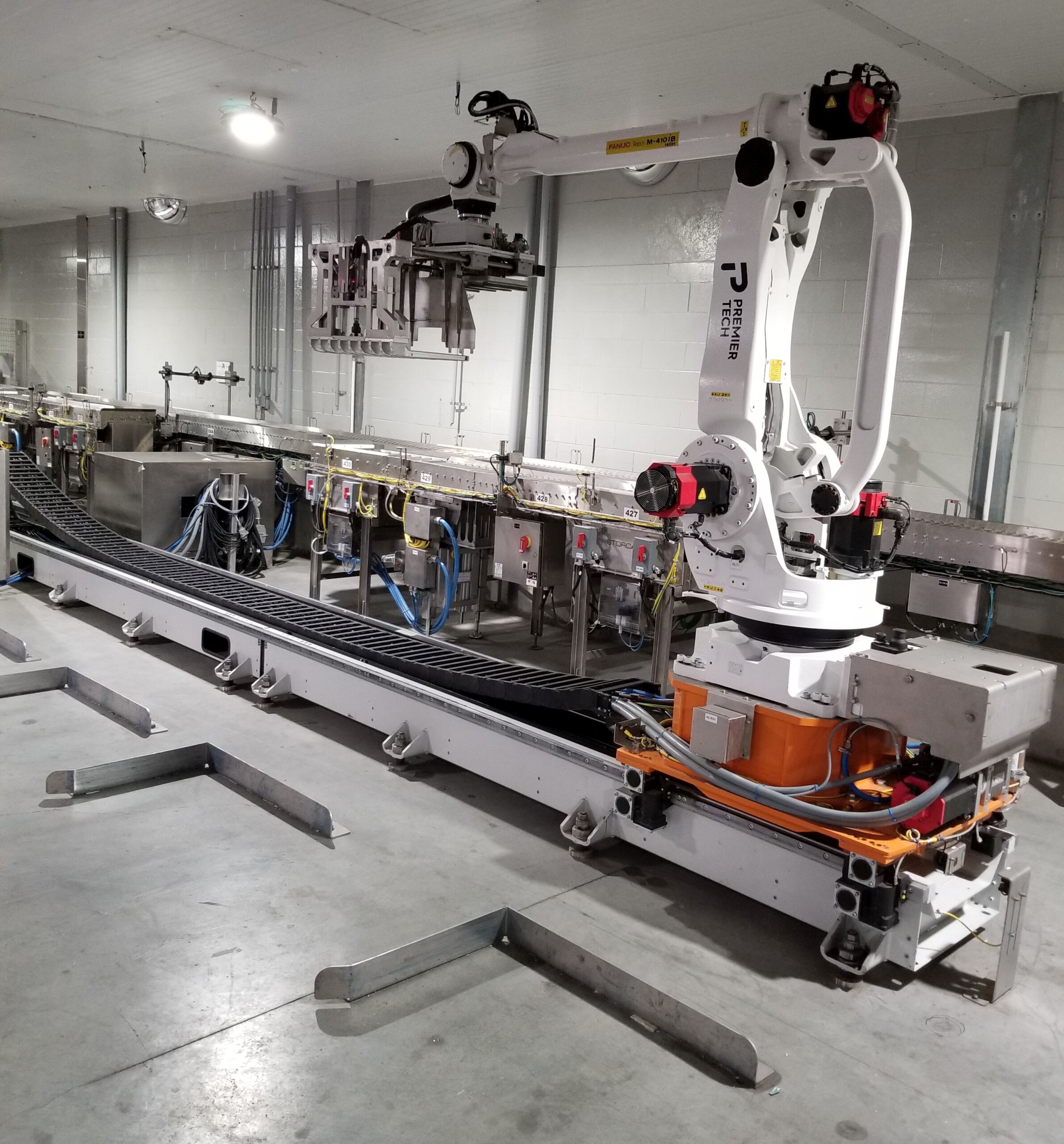
• Robotic palletizing: Multi-axis robot picks and places products (single or multiple picks) based on programmed patterns. Ideal for multi-format production, mixed pallets, scalability, frequent changeovers, and end-of-line flexibility.
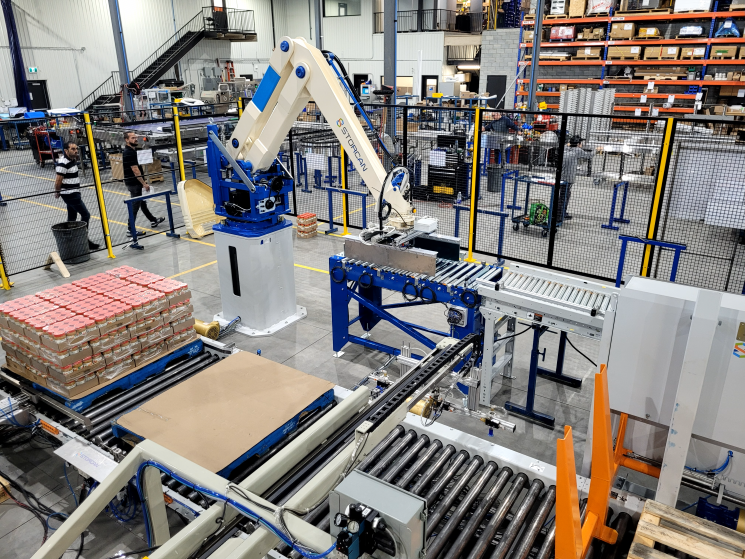
• Compact palletizer (small footprint): Optimized design to minimize floor space (often compact top-load configuration). Ideal for space-constrained facilities, end-of-line retrofits, and automation without expanding the palletizing area.
Key benefits
• Complete pallet preparation automation: integration possible with pallet dispensers, slip sheet dispensers, and pallet conveying systems
• Increased end-of-line productivity: fast and repeatable stacking at consistent throughput
• Reduced manual handling: decreased ergonomic risks related to heavy loads
• Pallet quality and stability: programmed patterns ensuring compact and secure transport loads
• Operational flexibility: management of multiple formats, multiple pallets, or palletizing recipes
• Optimization of space and material flow: coordination with conveyor systems, stretch wrapping, and internal logistics
• Traceability and connectivity: integration possible with MES, WMS, and line supervision systems
Technical specifications
- Technologies Conventional layer palletizer, robotic palletizer, semi-automatic cells
- Integrated brands Multi-supplier solutions depending on application
- Frame Welded steel frame or stainless steel construction depending on environment
- Throughput Variable depending on technology, product, and configuration (moderate to very high speed)
- Control & Automation PLC-based control, palletizing recipes, HMI interfaces
- Available options Pallet dispensers, slip sheet dispensers, pallet centering, conveyors, stretch wrapping, labeling, vision systems, AGV integration
Solutions tailored to your operations
Benefit from Storcan’s expertise to design a high-performance, scalable production line.
Read more